
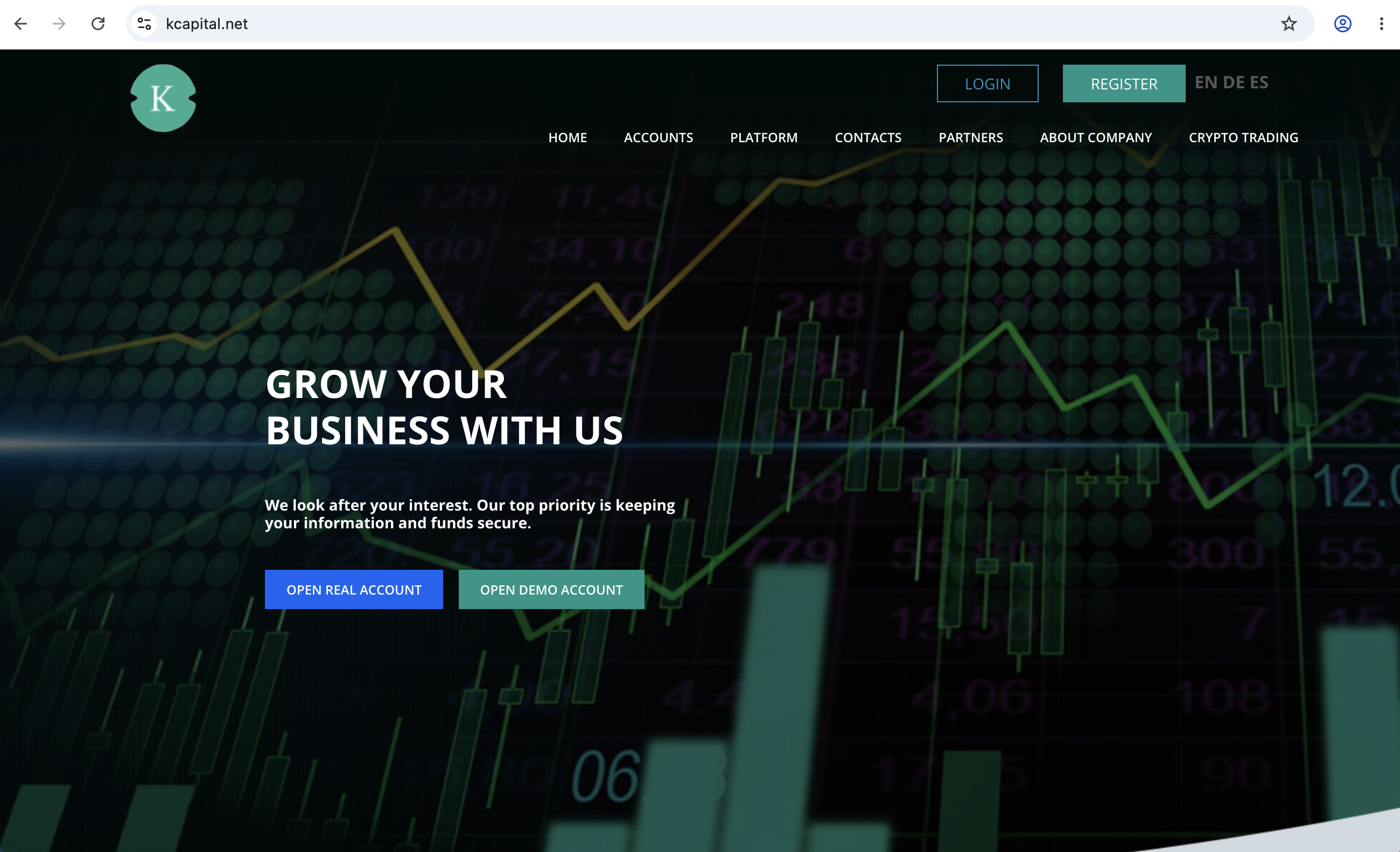

Can a trading platform be trusted simply because it looks professional? What happens when a broker promises access to thousands of financial instruments but provides limited transparency about who is actually operating the business? And how can investors distinguish between legitimate online brokers and platforms that may expose them to unnecessary risk?
These are important questions to ask when evaluating KCapital.net, a platform that presents itself as a provider of Contracts for Difference (CFDs), forex trading, cryptocurrencies, stocks, indices, and commodities. At first glance, the website displays many of the characteristics commonly associated with established brokers: sophisticated branding, promotional language focused on opportunity and growth, and claims of providing advanced trading technology.
However, a closer examination reveals a number of concerns that prospective investors should carefully consider before depositing funds. Regulatory observations, transparency issues, and broader operational patterns collectively create a picture that deserves scrutiny.
This review examines KCapital.net through the lens of fraud risk assessment, focusing on platform characteristics, behavioral indicators, operational structures, and the potential implications for investors.
Platform Breakdown
KCapital.net describes itself as an online broker offering CFD trading across multiple asset classes. According to information presented on its website, users can access more than 40,000 financial products and utilize trading platforms designed for desktop and mobile devices.
The platform promotes several key selling points:
- Access to forex markets.
- Cryptocurrency trading opportunities.
- Commodities and stock CFDs.
- Educational resources and market commentary.
- User-friendly trading technology.
While these features may appear attractive, they are relatively common among online brokerage websites. The more significant question is whether the company behind these offerings operates under recognized financial oversight.
One of the primary concerns identified during this review is the absence of clearly verifiable regulatory credentials from major financial authorities. Regulatory licensing is not merely an administrative formality; it serves as a mechanism designed to protect consumers through requirements related to capital adequacy, complaint handling, segregation of client funds, and operational accountability.
Independent reviews have consistently highlighted the lack of evidence supporting claims of regulatory authorization associated with KCapital.net. This absence places prospective users in a position where they may have limited recourse if disputes arise.
The platform also appears to rely heavily on generalized marketing language emphasizing opportunity, growth, and accessibility without providing equivalent detail regarding investor protections.
For sophisticated investors, the imbalance between promotional content and compliance information is often viewed as a warning sign rather than a competitive advantage.
Behavioral Signals
Fraud investigators frequently analyze behavioral signals rather than relying solely on a single piece of evidence. Many high-risk platforms do not reveal themselves through one obvious indicator. Instead, concerns emerge through patterns.
Several behavioral characteristics associated with KCapital.net warrant attention.
Limited Corporate Transparency
A legitimate financial institution typically provides extensive information regarding its legal entity, licensing jurisdiction, executive leadership, and dispute resolution mechanisms.
In contrast, publicly accessible information surrounding KCapital.net appears comparatively limited.
When investors cannot easily determine who ultimately controls a platform, accountability becomes difficult to establish.
Heavy Reliance on Aspirational Messaging
The website places considerable emphasis on future success, financial independence, and investment opportunity.
While marketing itself is not inherently problematic, platforms that focus extensively on emotional appeals while minimizing discussion of risks may inadvertently encourage unrealistic expectations among inexperienced traders.
CFD products are complex instruments involving leverage and substantial risk of loss.
Professional brokers generally emphasize this reality prominently.
Domain and Trust Concerns
Third-party monitoring services have raised concerns regarding the domain's trust characteristics.
ScamAdviser assigned KCapital.net an extremely low trust assessment and noted multiple factors contributing to that conclusion, including hidden ownership details and associations with higher-risk hosting environments. These observations do not independently prove fraudulent intent, but they do contribute to a broader risk profile that merits caution.
Short Operational History
The domain registration history associated with KCapital.net indicates relatively recent establishment compared with long-standing financial institutions.
Newly created investment platforms are not automatically illegitimate.
However, short operating histories combined with limited transparency significantly increase due diligence requirements.
Operational System
Understanding how a platform operates is essential when evaluating investor risk.
KCapital.net appears to function within the CFD brokerage model.
Under this framework, users speculate on price movements without acquiring ownership of the underlying assets.
This business model is legally permitted in many jurisdictions when conducted under appropriate regulatory supervision.
The challenge arises when oversight mechanisms are unclear.
Without recognized external supervision, investors may face several operational uncertainties:
- Limited clarity regarding order execution practices.
- Uncertainty about client fund segregation.
- Lack of access to established compensation schemes.
- Difficulty resolving disputes through independent authorities.
- Reduced transparency surrounding withdrawal procedures.
These concerns are not theoretical.
Regulators worldwide consistently warn consumers about investment platforms operating outside recognized frameworks.
Importantly, the Bank of Russia included KCAPITAL.NET on its warning list, citing signs associated with illegal professional securities market activity. The regulator's database indicates that warning indicators related to the platform were identified in May 2024.
Regulatory warnings do not automatically establish criminal wrongdoing.
However, they represent official concerns serious enough to warrant public disclosure.
Prudent investors should view such findings as significant factors in any decision-making process.
Another operational consideration involves withdrawal reliability.
Many investor complaints involving high-risk brokers do not initially center on account creation or deposits.
Problems frequently emerge later, when clients attempt to access their funds.
This pattern underscores the importance of verifying oversight structures before engaging with any online investment service.
Risk Analysis
Risk analysis involves examining how individual warning signs interact.
One isolated concern may have an innocent explanation.
Multiple concerns occurring simultaneously often justify heightened caution.
In KCapital.net's case, several factors converge.
Regulatory Ambiguity
The absence of easily verifiable licensing from major financial regulators remains one of the most significant concerns.
Regulated brokers are generally required to adhere to rigorous standards designed to protect consumers.
Without those safeguards, investors assume substantially greater risk.
External Warning Indicators
Independent review services have assigned unfavorable trust assessments to the domain.
Although such ratings should not be treated as definitive proof of fraud, they frequently reflect broader technical and transparency considerations that deserve attention.
Official Regulatory Findings
The inclusion of KCAPITAL.NET within the warning database maintained by the Bank of Russia elevates the platform's risk profile considerably.
Regulatory intervention typically occurs only after authorities identify issues deemed relevant to public protection.
Information Asymmetry
Investors appear to possess significantly less information about the platform's operators than the operators possess about their clients.
This imbalance creates an environment where consumers may struggle to make fully informed decisions.
High-Risk Product Offering
CFDs themselves are speculative instruments.
Even under ideal regulatory conditions, leveraged trading exposes participants to rapid financial losses.
When such products are offered through platforms with unresolved transparency concerns, the overall level of risk increases further.
For these reasons, prospective users should conduct extensive independent verification before depositing funds.
This may include:
- Confirming regulatory authorization directly with relevant authorities.
- Reviewing dispute resolution mechanisms.
- Testing customer support responsiveness.
- Carefully examining withdrawal policies.
- Seeking professional financial advice when appropriate.
What Can You Do If You’ve Been Affected?
If you've had any interactions with kcapital.net, it’s really important to take a breath and act quickly:- Stop sending any more money right away.
- Make sure to save all your records, like transactions and messages.
- Take a moment to evaluate your situation before making any more decisions.
Closing Insight
KCapital.net presents itself as a gateway to global financial markets, emphasizing accessibility, innovation, and opportunity.
Yet effective due diligence requires looking beyond polished interfaces and promotional claims.
The evidence reviewed in this assessment highlights several issues that should not be overlooked: limited regulatory clarity, questions surrounding transparency, unfavorable third-party trust indicators, and documented regulatory warnings issued by financial authorities.
None of these factors alone conclusively establish fraudulent intent.
Collectively, however, they create a risk profile that conservative investors would likely find difficult to ignore.
The online trading landscape continues to evolve rapidly, attracting both legitimate innovators and operators whose practices fall short of acceptable standards.
In this environment, skepticism is not cynicism—it is a necessary component of investor protection.
Before committing capital to any investment platform, individuals should ask a simple question:
If problems arise tomorrow, who is responsible, what protections exist, and how easily can those protections be enforced?
If clear answers are unavailable, caution may be the most valuable investment strategy of all.