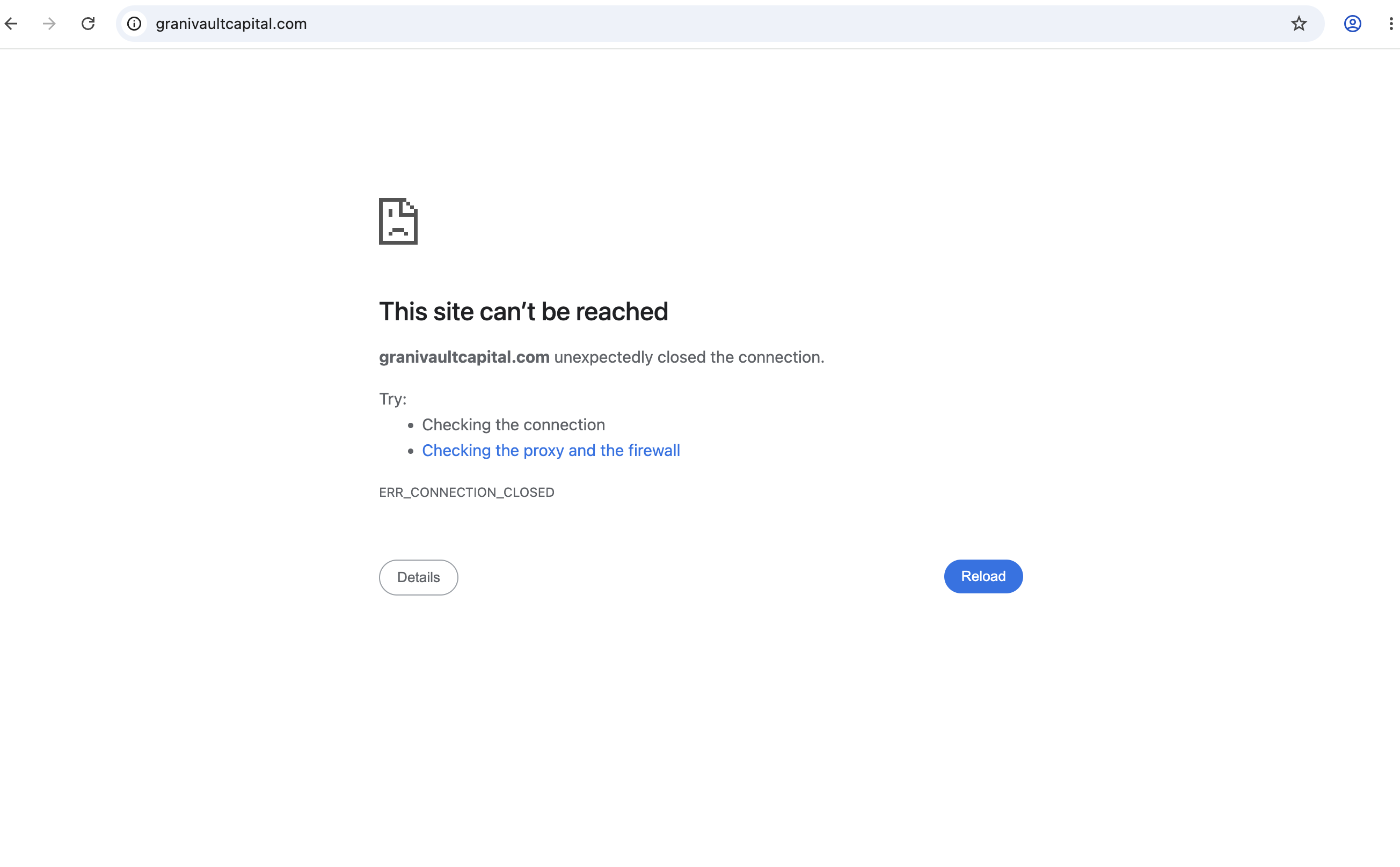
Introduction The world of alternative investments has expanded rapidly in recent years, offering individuals and institutions opportunities beyond traditional stocks, bonds, and real estate. Among these emerging platforms, Granivault Capital has gained attention as an unregistered investment provider, promising high returns through strategies that may include private equity, venture capital, or other alternative assets. However, the lack of regulatory oversight raises critical questions about its legitimacy, transparency, and risk profile.
This article provides an in-depth analysis of Granivault Capital , examining its investment offerings, operational practices, and potential drawbacks. Whether you're a seasoned investor or someone exploring alternative financial avenues, understanding the nuances of this platform is essential before committing funds.
What Is Granivault Capital? Granivault Capital positions itself as a private investment platform that facilitates access to alternative asset classes, such as private equity, venture capital, hedge funds, or structured credit. Unlike publicly traded investment vehicles, these assets often require significant capital and are typically accessible only to accredited investors.
The platform may appeal to those seeking:
Diversification beyond traditional markets Potential for higher returns (though with higher risk) Exclusive investment opportunities in niche sectors
However, the absence of registration with financial authorities (such as the SEC in the U.S. or equivalent regulators in other jurisdictions) introduces significant concerns regarding investor protection.
Granivault Capital’s Investment Offerings 1. Private Equity & Venture Capital Access Granivault Capital may provide exposure to private equity (PE) and venture capital (VC) funds , which invest in privately held companies. These investments are illiquid, meaning capital is locked in for years, and returns depend on the success of underlying businesses.
Potential Benefits:
Access to high-growth startups or established private firms Opportunity to invest in sectors like technology, biotech, or real estate
Key Risks:
Illiquidity – Investors cannot easily exit positions. High Minimum Investments – Many PE/VC funds require substantial capital (often $100,000+). Performance Uncertainty – Many startups fail, and even successful ones may take years to generate returns.
2. Hedge Fund & Alternative Strategies Some unregistered platforms offer hedge fund-like strategies, including:
Leveraged trading (futures, forex, or cryptocurrencies) Distressed asset investing Merger arbitrage or event-driven strategies
Potential Benefits:
Potential for uncorrelated returns (performance not tied to stock markets) Sophisticated strategies that may outperform traditional investments
Key Risks:
High volatility and potential for significant losses Lack of transparency in reporting and strategy execution Performance fees (often 2% management + 20% of profits) that can erode returns
3. Structured Products & Private Debt Granivault Capital might also offer structured notes, private credit, or debt instruments that promise fixed or variable returns.
Potential Benefits:
Predictable income streams (if structured as bonds or loans) Higher yields compared to traditional fixed-income investments
Key Risks:
Counterparty risk (if the issuer defaults) Complexity – Many structured products are difficult to understand Limited liquidity – Early exit may not be possible
Operational Practices: Transparency & Governance Concerns 1. Lack of Regulatory Oversight One of the most significant drawbacks of Granivault Capital is its unregistered status . Unlike registered investment advisors (RIAs) or broker-dealers, unregistered platforms are not subject to the same disclosure, auditing, or compliance requirements .
Implications:
No mandatory financial audits – Investors rely on self-reported data. No regulatory recourse – If fraud occurs, victims have limited legal protections. Potential conflicts of interest – Platforms may prioritize their own profits over investor returns.
2. Fee Structure & Hidden Costs Many unregistered platforms employ opaque fee models , including:
Management fees (1-2% annually) Performance fees (10-20% of profits) Early withdrawal penalties Administrative or "platform" fees
Example Scenario: An investor commits $500,000 to a Granivault Capital fund with a 2% management fee + 20% performance fee . If the fund grows to $700,000, the investor pays:
$10,000 in management fees $40,000 in performance fees (20% of $200,000 profit)
Total fees: $50,000 (10% of gains) This structure can significantly reduce net returns , especially in underperforming funds.
3. Due Diligence & Investor Protection Since Granivault Capital is unregistered, investors must conduct extensive independent research before committing funds. Key questions to ask:
Who are the fund managers? (Background, track record, past failures) What is the investment strategy? (Is it clearly defined or overly vague?) Where is the capital held? (Segregated accounts vs. commingled funds) What are the redemption terms? (Lock-up periods, exit penalties)
Red Flags to Watch For:
Vague or overly optimistic projections (e.g., "guaranteed 20% annual returns") Pressure to invest quickly ("Limited-time offer!") Lack of third-party audits (Financial statements not verified by a reputable firm) No clear exit strategy (How will investors cash out?)
Potential Drawbacks & Risks 1. Illiquidity & Capital Lock-Up Most alternative investments offered by Granivault Capital are illiquid , meaning investors cannot easily sell their positions. Common lock-up periods include:
3-7 years for private equity/VC funds 1-3 years for hedge fund-like strategies No early exit option in many cases
Consequence: If an investor needs liquidity (e.g., for an emergency), they may be forced to sell at a loss or wait years to recover capital.
2. High Minimum Investments Many unregistered platforms require substantial capital commitments , often:
$100,000+ for private equity/VC funds $50,000+ for hedge fund-like strategies $25,000+ for structured products
This excludes retail investors and limits participation to high-net-worth individuals or institutions.
3. Performance Uncertainty & Lack of Benchmarks Unlike publicly traded funds, alternative investments often lack clear benchmarks for performance comparison. Investors may struggle to assess whether Granivault Capital’s returns are:
Truly exceptional (beating market averages) Average or below-average (justifying high fees) Misleading (due to survivorship bias or cherry-picked data)
4. Regulatory & Legal Risks Unregistered platforms operate in a gray area of financial regulation. While some may be legitimate, others could be fraudulent or operating illegally .
Possible Legal Issues:
SEC or CFTC enforcement actions (if deemed an unregistered securities offering) Investor lawsuits (if misrepresentation or mismanagement occurs) Bankruptcy risks (if the platform fails, recovery may be difficult)
Who Should Consider Granivault Capital? Granivault Capital (or similar unregistered platforms) may be suitable for: ✅ Accredited investors (meeting net worth/income thresholds) ✅ Sophisticated investors with experience in alternative assets ✅ Those seeking diversification beyond traditional markets ✅ Investors willing to accept illiquidity and high risk Not suitable for: ❌ Retail investors (lack of regulatory protections) ❌ Those needing liquidity (long lock-up periods) ❌ Risk-averse individuals (high volatility and potential losses) ❌ Investors who cannot conduct thorough due diligence Alternatives to Consider If Granivault Capital’s risks outweigh its benefits, investors may explore regulated alternatives , such as:
Registered Private Equity Funds (e.g., Blackstone, KKR) Publicly Traded BDCs (Business Development Companies) (e.g., Ares Capital, Main Street Capital) Crowdfunding Platforms (e.g., Republic, SeedInvest – for accredited investors) ETFs & Mutual Funds with Alternative Strategies (e.g., ARK Innovation ETF, hedge fund replication strategies) Self-Directed IRAs (for tax-advantaged alternative investments)
Final Verdict: Should You Invest in Granivault Capital? Granivault Capital presents an opportunity for high-net-worth investors seeking exposure to alternative assets. However, the lack of regulatory oversight, illiquidity, high fees, and performance uncertainty make it a high-risk proposition .
Before investing, ask yourself: ✔ Do I fully understand the investment strategy? ✔ Can I afford to lose this capital? ✔ Have I verified the fund managers’ track records? ✔ What are the redemption terms, and how will I exit if needed? ✔ Are there any regulatory complaints or legal issues against the platform? If the answers are unclear or unsatisfactory, proceed with extreme caution —or consider regulated alternatives with stronger investor protections.
What Can You Do If You’ve Been Affected? If you've had any interactions with granivaultcapital.com, it’s really important to take a breath and act quickly:
Stop sending any more money right away. Make sure to save all your records, like transactions and messages. Take a moment to evaluate your situation before making any more decisions.
Getting your funds back in these cases can be tough and is usually a step-by-step process.
We’re here to offer some guidance to help you understand your options and what you might want to consider next.
👉 Head over to our Contact Us page to learn more and get the support you need.
Conclusion Granivault Capital exemplifies the trade-offs between opportunity and risk in the world of unregistered investments. While it may offer access to exclusive, high-return strategies, the lack of transparency, regulatory gaps, and potential for mismanagement make it a venture best suited for experienced, high-net-worth investors .
For most individuals, traditional investment vehicles (index funds, ETFs, bonds) or regulated alternative funds may provide a safer path to diversification. As always, due diligence is paramount —never invest in what you don’t fully understand.